Wolford halves its losses: inside the hosiery icon's turnaround
In the first half of 2026 the operating loss fell from €22.8 million to €10.2 million, but revenue is still shrinking and the cash comes from Fosun's loans. The Bregenz brand's accounts, read by people who buy tights.
On 18 September 2026, in Bregenz, chief executive Marco Pozzo and chief operating officer Ralf Polito signed Wolford's half-year report. It contains the good news the brand had been waiting three years for: between January and June the operating loss fell to €10.2 million, from €22.8 million in the same period of 2025. Halved, or near enough. And it contains the less good news: revenue fell again, to €31.0 million from €33.0 million, and the cash still depends on loans from the majority shareholder, China's Fosun. For anyone who buys tights the question is simple: will the brand that invented the luxury tight make it, and what changes in the shops meanwhile?

Wolford's headquarters in Bregenz, on Lake Constance, in April 2026: 183 of the 603 employees work here. Photo: Eweht, CC BY-SA 4.0, via Wikimedia Commons.
What the half-year accounts say
The numbers, all from the report. The net loss went from €33.6 million to €16.9 million. Free cash flow, the money that leaves the company after investments, improved from −€23.7 million to −€12.9 million. Personnel costs fell 18.5%, to €18.3 million, because the average headcount dropped from 719 to 615 full-time equivalents; other operating expenses fell 22%. This is the part of the cure that is working: the company spends much less than before.
The part that is not working yet is sales. The report says that in stores open for more than a year sales "recorded a slight increase", that online "continued to show encouraging growth", and that the overall decline comes from closed stores and from a wholesale channel that last year had benefited from deliveries bunched into the first half. The mix has changed a lot in twelve months: boutiques are 39% of sales, down from 48%; online is 26%, up from 21%; specialist retailers 15%, up from 6%; department stores 8%, up from 5%. Legwear, the heart of the brand, is 46% of turnover, up from 43%.
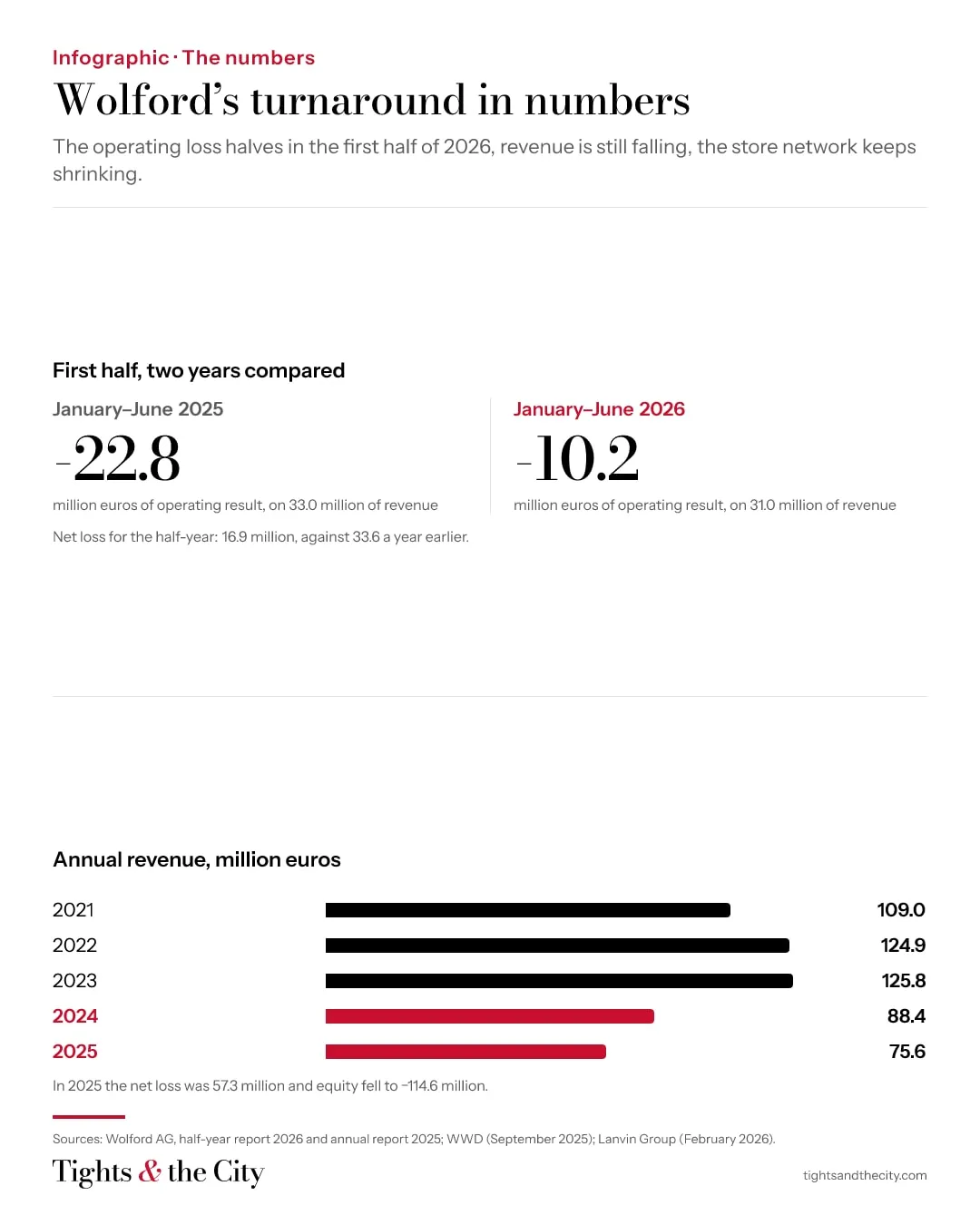
The half-year compared, revenue over the last five years and the sales network in June 2026. Source: Wolford AG.
Then there is the balance sheet, which is scarier. Equity is negative by €133.6 million, worse than the −€114.6 million at the end of 2025; net debt has risen to €144.3 million; cash at the end of June was €3.8 million. Current liabilities exceed total assets by €92 million, and the report states, as the law requires in such cases, that "a material uncertainty exists that may cast significant doubt on the Company's ability to continue as a going concern". The accounts are still drawn up on a going-concern basis for one reason: the shareholders' commitments.
Who pays: Fosun
Since 2021 Fosun Fashion Group, the Cayman company through which the Shanghai conglomerate controls Wolford, has been lending the company money at 12% a year, on one-year terms that get extended. At the end of June 2026 the loans stood at €103.6 million plus $18 million, before interest; with accrued interest, liabilities to shareholders reach €148.8 million. No repayment has ever been made. Another €14.1 million arrived in the first half, then €6.5 million in July, €2 million in August and €1 million in September. The loans are subordinated: they will be repaid only once the restructuring is complete or, in a liquidation, after every other creditor.
This is the mechanism that has kept the brand standing for two years, and the report says so plainly: the going-concern assessment "reflects the Group's ongoing reliance on shareholder support", because "sustainable profitability has not yet been achieved".
Where the crisis came from
To understand the 2026 figures you have to go back to 2024. In 2023 Wolford still had revenue of €125.8 million, in line with €124.9 million in 2022. The following year revenue collapsed to €88.4 million, 30% less, with a net loss of €51.7 million. Not for lack of customers, the company has always argued, but because the goods did not arrive: in May 2025 FashionUnited reported the company's words about "an abrupt interruption in the supply chain" in the last quarter and the €29 million of loans received from Fosun to hold up liquidity. In the autumn of 2024, Austrian broadcaster ORF reported, the then new chief executive Regis Rimbert announced a full overhaul of supply, inventory and logistics.
2025 was the year of the clean-up, and it shows in the accounts published in April 2026: revenue of €75.6 million, another 14.5% down; an operating loss of €40.2 million, a net loss of €57.3 million, the worst ever; average headcount down to 684 from 859 in 2024 and 1,008 in 2023. Equity, a positive €15 million in 2021, reached −€114.6 million. In the preliminary figures reported by FashionNetwork in March, sales had fallen 12% in Europe, 18% in Greater China and 19% in North America. The annual report adds a detail that explains a lot: many wholesale customers had "reduced their order volumes following delivery interruptions in 2024 and 2025", a problem "resolved in the meantime", but trust is rebuilt more slowly than stock.
In the summer of 2025 the shareholders subscribed a €25 million capital increase. On 7 July 2025 Marco Pozzo, an Italian, joined the management board as deputy chief executive; from 1 March 2026, Lanvin Group announced in late February, he is chief executive and chairman of the management board.
The cure
The cure has three ingredients. The first is cost cutting, and the store network is the most visible chapter: Wolford had 163 mono-brand points of sale at the end of 2024, according to the figures Pozzo gave WWD in September 2025, 147 in June 2025, 132 at the end of 2025 and 122 at the end of June 2026. Forty-one stores closed in eighteen months, mostly the loss-making ones; of the 132 at the end of 2025, 43 were run by partners. Employees numbered 1,081 in 2021 and are now 603.
The second ingredient is a change of channels. In the report, wholesale "remains a key growth driver": more collections, more categories, seasonal capsules to win new multi-brand accounts in Europe, the United States and China. E-commerce is being relaunched with a "full-service" model in about 120 countries. The remaining boutiques have to "consolidate" and each produce more. In other words, Wolford wants to be less a chain of its own stores and more a brand you find at other people's, as it used to be.
The third is the product. The report talks about a "product system" built on layering, in which essential pieces combine with trend pieces; about faster capsules tied to commercial moments; about a "price architecture" strengthened "to reinforce premium perception"; about more urban ready-to-wear; about artificial intelligence for forecasting and decisions; about the OEKO-TEX Made in Green certification. The Autumn/Winter 2026 collection is the first born entirely under the new course: python-effect jacquard, merino wool, a crystal catsuit. The stated target for the second half of 2026 is growth over last year. The tone, in their words, is one of "disciplined optimism".

The Fatal, the tube dress Wolford has made for decades: ready-to-wear is 42% of sales. Photo: Tobias ToMar Maier, CC BY-SA 3.0, via Wikimedia Commons.
What changes for shoppers
A brand in restructuring does not mean a worse product. Production has not moved: all the legwear and a good part of the ready-to-wear are knitted and dyed in the plants in Bregenz and in Murska Sobota, Slovenia, both bluesign-approved, and 90% of material suppliers are in Europe. Anyone who chooses Wolford for the hand of the Satin Touch or the fit of the Individual 10 finds the same product as before; if you want a yardstick for what the price buys, our guide to denier explains why a well-made 10 or 20 denier sheer costs more than a supermarket pair.
What changes is where you find them. With 122 boutiques worldwide, many cities that had a Wolford store no longer do; in return the brand is going back into specialist shops and department stores, which together went from 11% to 23% of sales in a year, and online is now a quarter of the total. If your boutique has closed, that is where to look.
Prices change too, but not downwards. The report explicitly describes a price architecture designed "to reinforce premium perception": do not expect the turnaround to come through discounts on the classics. On the European site a set of three Satin Touch 20 costs €56, under €19 a pair, and it is the cheapest way to try the brand. For bargains there are the outlets, which account for 4% of sales: the Bregenz one, on Rheinstraße, is in the same building as the headquarters.
The Bregenz Factory Outlet, April 2026: outlets account for 4% of sales. Photo: Eweht, CC BY-SA 4.0, via Wikimedia Commons.
And availability changes, for the better. The interruptions of 2024 and 2025 are the reason many styles were missing for months; the report lists "delivery reliability" and "never-out-of-stock continuity" on key products among its priorities. It is the promise that matters most to shoppers, and the easiest to check: walk into a store and ask for your style in your size.
The milestones
- 1950. In Bregenz, the Wolff & Co. founded the year before takes the name Wolford.
- 1995. Listing on the Vienna Stock Exchange.
- 2018. Fosun becomes the majority shareholder; Lanvin Group, which brings together Lanvin, Wolford, Sergio Rossi and St. John, follows.
- 2023. Revenue of €125.8 million, net loss of €30.8 million.
- 2024. Supply interrupted in the last quarter, revenue of €88.4 million, net loss of €51.7 million; shareholder loans.
- 2025. €25 million capital increase; revenue of €75.6 million, net loss of €57.3 million; 684 average employees.
- 2026. Marco Pozzo chief executive from 1 March; in the first half the operating loss falls to €10.2 million.
The next test
The first-half accounts say that the cost cure has worked and that demand, where Wolford is still present, is holding. They do not yet say that the company can stand on its own: every month of losses is covered by Fosun, at 12% interest. The real test is the second half, the one that matters most for a tights brand, with autumn and Christmas: if revenue grows again as promised, 2026 will be the first year in three to close better than the one before. Otherwise the question, in Shanghai, becomes how much longer it is worth paying for a brand that, in Bregenz, still makes tights very well.
The other brand stories on Tights and the City: Wolford's history from 1949 to today, Falke and Fogal; and, to see the brand on the runway, Kaia Gerber's polka dots.