Thermal tights: how to choose the warmest pair
Fleece-lined, wool or merino, high-denier microfibre and the viral fleece tights that look sheer: what really keeps you warm, with official compositions, and which to choose for each day.
"Thermal" is a word every brand uses as it likes: no standard says how warm tights have to be to earn the name. What really keeps you warm are three measurable things: the air the knit traps next to the skin, the fibre it is made of and the amount of yarn, which is the denier. This guide lines up the four families of thermal tights, with the compositions read on the official product sheets, and says which to choose for each kind of day.
What really keeps you warm
Tights do not produce heat: they hold it. They do so in three ways.
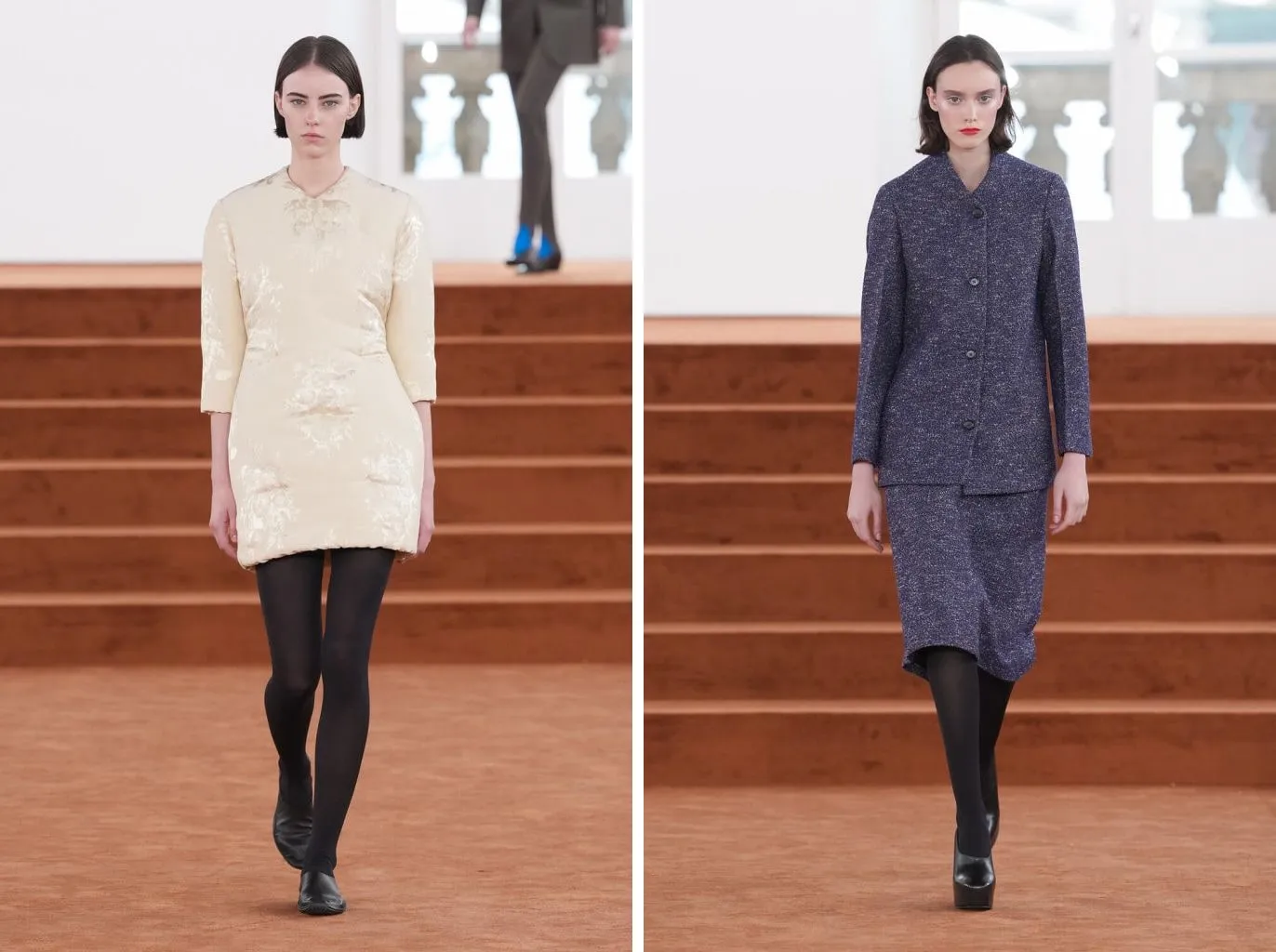
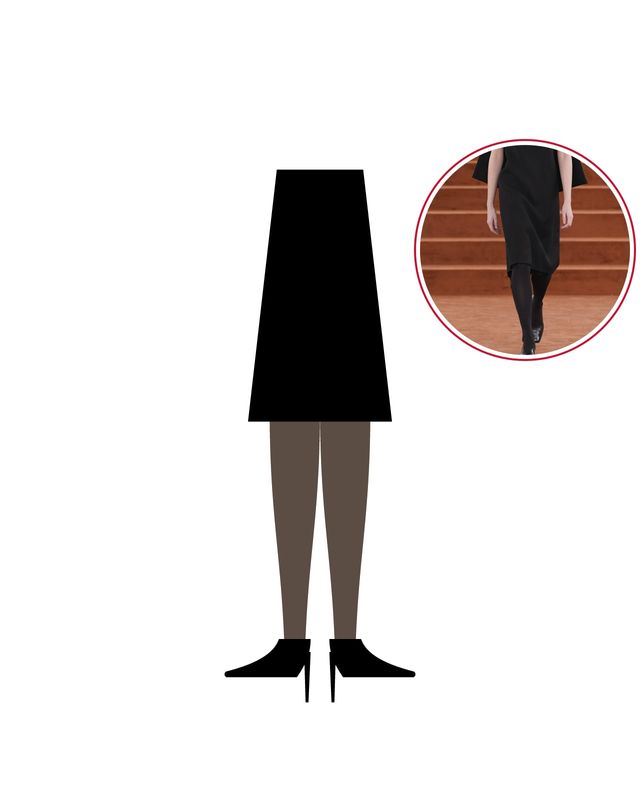
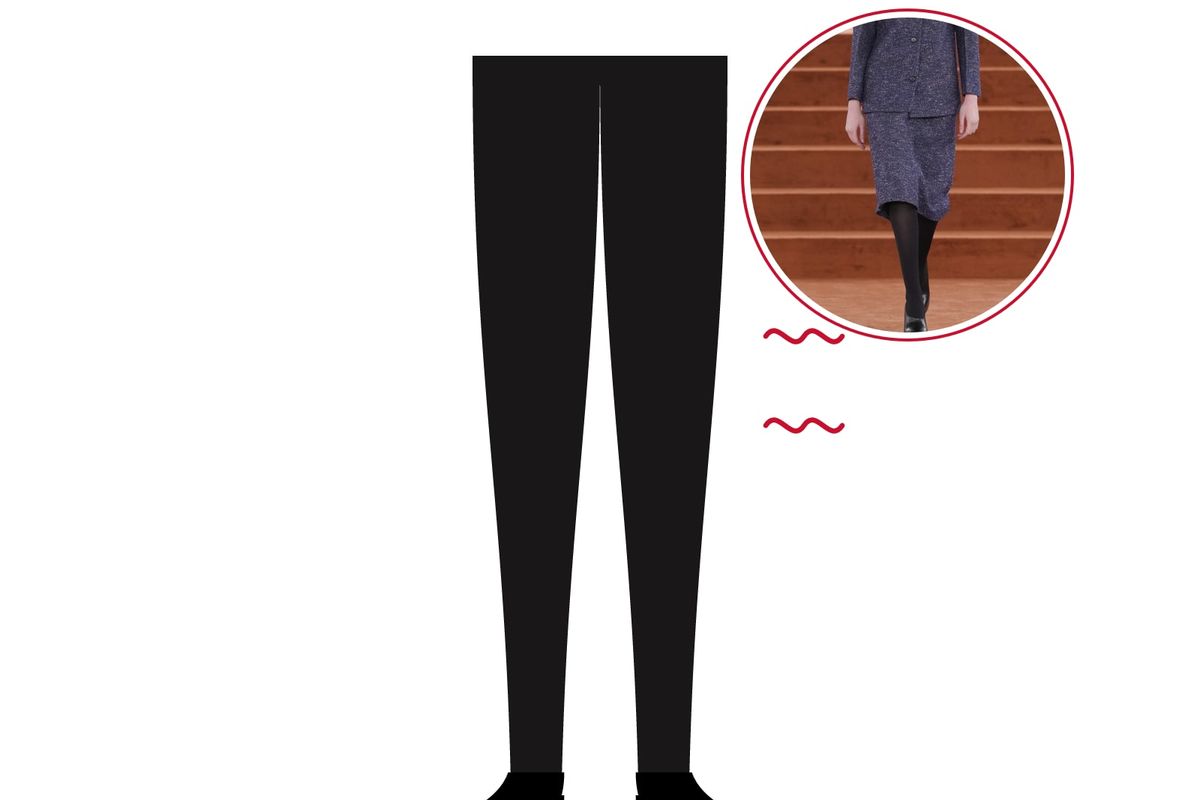
Jil Sander's full opaques for Fall/Winter 2026: matte black with the cream mini dress and loafers, and with the purple tweed skirt and platform loafers. Photo: Camera Nazionale della Moda Italiana.
- Air. A fleece-lined knit, brushed on the inside, traps a layer of air between the yarn and the skin: it is the same principle as fleece. The softer the inner surface, the more air it traps.
- Fibre. Wool holds warmth even when damp and lets vapour through; brushed polyester is very warm and dries fast but breathes less; microfibre polyamide is dense and smooth, and warms by density. The glossary explains what microfibre is. For what each fibre is and how to read the label, see what tights are made of.
- Denier. For the same fibre, more yarn means more warmth. A 100-denier opaque is warmer than a 60, and the difference between a 40 and a 15 is enormous. The denier guide explains the scale.
Wind and time spent outdoors count as much as the tights: an 80 denier is enough for getting to the office in town, not for a day outside in January.
The four families
Fleece-lined
These are the tights with a fleece or brushed inside. They are the warmest of all, the thickest and the least elegant: the colour is solid and the leg loses its shape. They work with boots, heavy skirts and long coats. Typical compositions are polyester or polyamide with elastane; the most opaque styles declare 200 denier and more. They have less stretch than sheers: if you are between two sizes, the size chart guide says to take the one up, and here it counts double.
Wool and merino
Wool warms without bulk and breathes: it is the choice for anyone who moves between the cold and the heating many times a day. Merino is a fine, soft wool that does not itch. Falke presents its Softmerino tights as a combination of soft merino wool on the outside and cotton against the skin, for "excellent temperature regulation"; retailers class them at around 70 denier. Wolford, in its autumn/winter 2026 collection, bet on thermoregulating merino wool.
In October the brand went further, with its first capsule made with Woolmark, the wool certifier: seven bodywear pieces in merino, 100% in the Pure Wool tops and 85% blended with stretch fibres in the Seamless Wool dress, top, skirt and bodysuit, with a top at 295 euros, according to Luxe Digital; Wolford's own product pages, however, list Seamless Wool as 59% virgin wool, 37% polyamide and 4% elastane. CEO Marco Pozzo spoke of more than a year of work on yarns, dyeing and wash tests. There are no tights in the capsule, and Wolford has not said whether legwear will follow, even though legwear is still 46% of its sales. For merino on the legs, the brand already sells its Merino Tights.
Wool and merino tights cost more and last longer, provided you wash them like wool. On the two brands' history: Falke and Wolford.
High-denier microfibre
These are the 80, 100, 120-denier opaques in microfibre polyamide: smooth, uniform, with a solid colour and a leg that still shows its shape. They warm by density, not by thickness, and remain the most elegant of the thermals: with a knee-length skirt and a pump they look like ordinary opaques. The 3D knit, with elastane in every course, makes them more uniform and more resistant. In real cold, on their own they are not enough.
Fleece-lined with a sheer look
These are the tights that went viral on TikTok: from a distance they look like black 30-denier sheers, in reality they are two layers. The official sheets explain it without mystery. Calzedonia describes its Sheer-Effect Thermal Tights as the union of two articles, "a pair of skin-coloured tights in contact with the skin and a pair of black 30-denier sheer tights", with the outer layer in 85% polyamide and 15% elastane and the inner one in 92% polyester and 8% elastane, at 19.95 euros. Oroblù offers the Thermo-Nude, "thermal tights with a double knit construction and a special 30-denier sheer effect", in 53% polyester, 31% polyamide and 16% elastane, with flat seams, a gusset and a comfortable waistband, at 25.50 euros.
Do they work? Yes, with two limits. The first is distance: from a metre away the sheer effect holds, up close you can tell the inner layer is a solid fabric and not skin. The second is skin tone: the inner layer comes in a single shade of beige, and on darker or lighter skin the illusion falls. A journalist who tried them for Insider, in a piece picked up by Yahoo, found them "practical" but noted that "there needs to be more inclusive options". They are still far warmer than a real 30 denier, and less warm than full fleece.
Which to choose for each day
| Day | Tights | Why |
|---|---|---|
| Heated office, short journeys | 60–80 denier microfibre | Warm enough, elegant leg |
| City, in and out all day | 100–120 microfibre or wool/merino | More warmth without bulk, breathes |
| A day outdoors, wind, snow | Full fleece-lined | Traps the most air of all |
| Elegant evening in the cold | Fleece-lined sheer look | Looks like a 30 denier, warms like an opaque |
| Under trousers or tall boots | Fleece-lined or 100 microfibre | Does not show, only warmth counts |
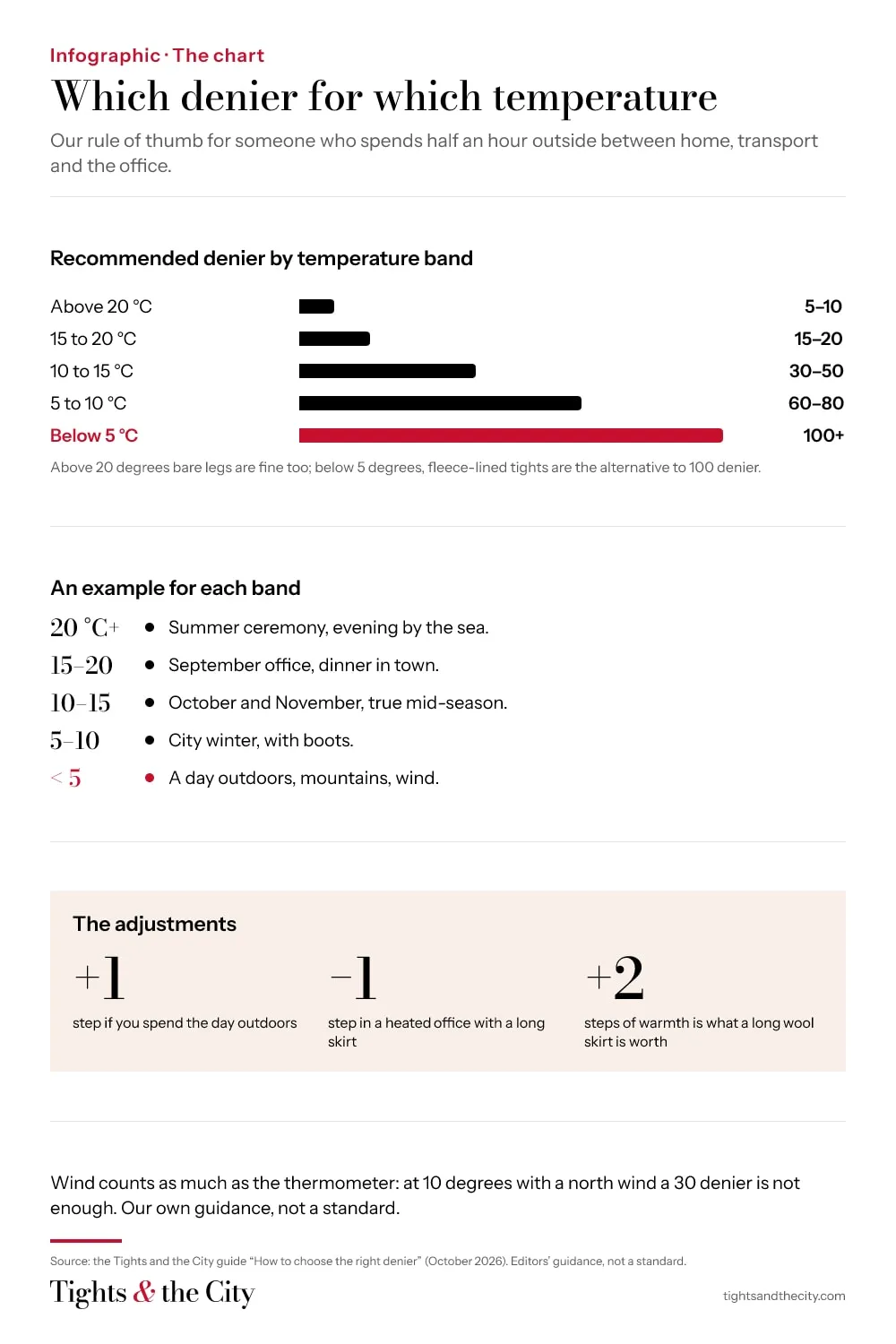
Which denier for each temperature band: our chart, with the adjustments for wind and long skirts.
Two pairing rules hold for all of them: with thermals the shoe is closed, and the colour stays dark, because a light fleece shows every crease. For pairings with a black dress, the guide to the colour with a black dress covers opaques too.
How to wash them
The official Calzedonia and Oroblù labels for the sheer-look thermals say "hand wash, maximum temperature 40°C", no bleach, no tumble dryer and no ironing. For full fleece the same applies, with one extra care: squeeze them inside a towel, because fleece holds a lot of water, and lay them flat away from the radiator. Wool and merino want the wool cycle or a hand wash with a specific detergent, and they dry flat, never hung, because the weight of the water stretches them. All the rules for not ruining them are in the guide on how to stop tights from laddering.
In short
- "Thermal" is not a measurement: look at the fibre, the denier and the type of knit.
- Fleece-lined for real cold, wool and merino for those going in and out, high-denier microfibre for elegance, sheer look for the evening.
- Fleece-lined sheer-look tights are two layers: they work from a distance and only in your own skin tone.
- By hand at 40 degrees, no tumble dryer, wool apart.
The other guides are gathered in the complete guide to tights.